Tuesday, December 15, 2009

Non-Fiction (Intermediate)


Title: The Lamp, the Ice, and the Boat Called Fish
Author: Martin, Jacqueline Briggs
Illustrator: Krommes, Beth
Publisher & Date: Houghton Mifflin Company, 2001
Genre: Non-Fiction
Age Range: 2nd-5th grade
Summary: This book is based on a true story about a voyage to the Canadian Arctic. there are lots of people on this boat including an Inupiat family and Inupiat hunters. Even with the knowledge and skills the Inupiat people have of survival techniques, the crew's survival in the Arctic conditions seem very slim.
Response: This book was very hard to get into. It seemed like it kept dragging on and on. The illustrations were very captivating and did an excellent job supporting the story. It is written in a somewhat poetic manner. The thing that I liked about the book was at the end, the author listed the passengers, the crew, and the animals that were aboard the ship. There are also some photographs of some of the actual passengers. I also liked how the back cover of the book is a map showing the path the ship took.

Non-Fiction (Intermediate)


Title: The Great Expedition of Lewis and Clark
Author: Edwards, Judith
Illustrator: Comport, Sally Wern
Publisher & Date: Farrar Straus Giroux, 2003
Genre: Non-Fiction
Age Range: 4th-6th grade
Summary: This books tells the journey of Lewis and Clark. It is told by a man who is apart of the Corps of Discovery, named Private Reubin Field. It tells of the struggles they faced and the difficulties the encountered. It tells of all the different people they met along their journey.
Response: this illustrations in this book remind you of the time period the expedition took place. The illustrations helped you capture the events of that time very well. I really liked all the facts and history stuffed in this book. This would be a good book to use in a social studies class. Teachers need to be sure that all the statements in this book are factual before using it though.

Non-Fiction (Primary)


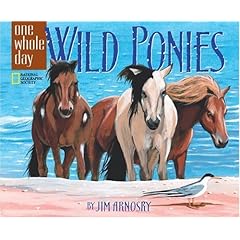
Title: Wild Ponies
Author: Arnosry, Jim
Publisher & Date: National Geographic Society, 2002
Genre: Non-Fiction
Age Range: K-2nd grade
Summary: This book tells what the wild ponies and other animals on Assateague Island do all day.
Response: This book is a very primary information book. It uses rhyming on each page to make it easier for younger children to read and understand. The text is very large and not very much text is placed on each page. I chose this book because I love horses, and I have actually been to Assateague Island. At the end, in the author's note, it gives some more information about the island and the animals that inhabitant it.

Non-Fiction (Primary)


Title:The Librarian of Basra
Author: Winter, Jeanette
Publisher & Date: Harcourt Inc, 2005
Genre: Non-Fiction
Age Range: 1st-4th grade
Summary: The library in Basra, Iraq was a place where people met to discuss earthly and spiritual matters. But, then their discussions became only about war. The librarian asked the governor if the books could be moved so that they would not get destroyed during the war. He said no, but the librarian secretly transported the books to a neighboring restaurant. Nine days later her library got burnt to the ground. She moved all 30,ooo books to her house and she dreams of a new library where her books will be safe.
Response: Although there are not many words per page, this is a powerful story. It is very relevant to today's current situations in the war, but it is from an Iraqi's perspective. This librarian cared so much for her books. She was able to save about 70% of her books. These people live in fear wondering when the next attack will come. I think this book would be great to help children understand how the Iraqi people's lives have been changed because of all the attacks. It also shows children how much these people value books. I really enjoyed the illustrations and use of colors.

Monday, November 16, 2009

Biography


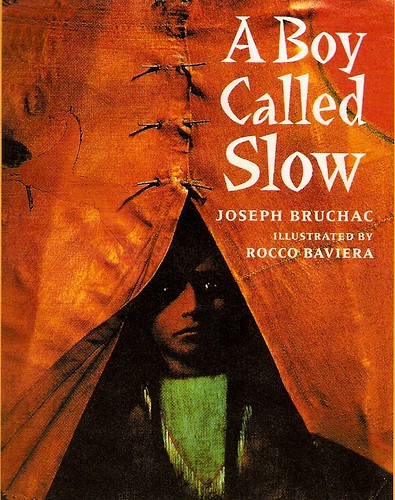
Title: A Boy Called Slow
Author: Bruchac, Joseph
Illustrator: Baviera, Rocco
Publisher & Date: Philomel Books, 1994
Genre: Biography
Age Range: 2nd-5th grade
Summary: Every Lakota Indian is named when they are born, by how they act as a child. When Returns Again's son was born, they noticed that he was slow to react, so his name became Slow. He was teased when he was older and did not like his name. So, in order to change his name, he had to do a great deed or win a major victory. When he was 14, he went with his father on his first war battle. Because of him, his tribe was able to obtain many more horses and supplies because of his victory in the battle. Because of this victory, they named him Sitting Bull.
Response: This biography read more like a story than the typical boring biographies. I could see how this could be a beneficial book when talking about Native Americans. The book incorporates many Indian words in the context of the story with it's meaning. With this biography, children would learn a lot about the Lakota Indian culture.

Biography


Title:How Ben Franklin Stole the Lightning
Author: Schanzer, Rosalyn
Publisher & Date: Harper Books, 2003
Genre: Biography
Age Range: 1st-4th grade
Summary: This book discusses Benjamin Franklin's life and all the things that he invented. It then discusses the invention he is best known for, the lightning rod. He took the time to understand everything about electricity to help benefit mankind.
Response: This is a great child friendly biography. It allows children to understand all the great things Ben invented. The illustrations really enhance and compliment the story of his life. This would be an awesome book to use in a science or history class. Most biographies are really dry, but this illuminates Ben's life, making it much more colorful and alive.

Wednesday, October 28, 2009

Graphic Novel


Title: The Legend of Hong Kil Dong: The Robin Hood of Korea
Author: O'Brien, Anne Sibley
Publisher & Date: Charlesbridge, 2006
Genre: Graphic Novel
Age Range: 1st-4th grade
Summary: Kil Dong was born to a minister, but In Hyung was destined to the position of minister and Kil Dong was just a low life. He wanted to find his place in the world that he was destined for. Everyone teased Kil Don and he couldn't take the humiliation, so he went to a monastery and studied with them. The ancient sage took him as his disciple, teaching him martial arts and magic. He went back home and everyone started spreading rumors that he was a criminal. He left for the mountains and lifted a rock that no one else could possibly lift and the people saw that heaven had sent them a leader. Kil Dong did not like to see injustice and adversity. So, he taught these people fighting skills and battle strategy. They went into several provinces and stole from the rich and gave to the poor. He finally goes to King Se Jong and tells him of all the corruption in his land. The King makes him a minister and he and his bandits sailed to an island to create a just a virtuous society.
Response: This is a great book to teach children about the Korean culture. In the back of the book, it talks about that author and the legend and Korean words and meanings. This book's style is very easy to read and follow. This book would definitely attract boys to reading. Also it brings about the idea of countries having injustices. I know when I was a kid, I thought that everyone grew up like me. So, this book would point out that there are problems in every country.